
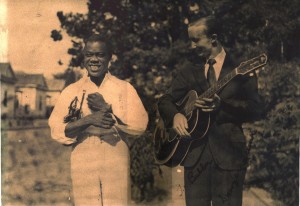
Snoozer Quinn was an early jazz banjoist and guitarist from Bogalusa, La., whose contemporaries were Eddie Lang and Lonnie Johnson. The golden years of his career, from 1925-1932, were mostly spent with territory dance bands touring throughout the South and Southwest, like the Paul English Traveling Shows, Peck’s Bad Boys, the St. Louis Rhythm Kings, the Louisiana Ramblers, the Mart Britt Orchestra, and Robert E. Lee and His Confederates.
Snoozer also played with renowned musicians like Paul Whiteman, Louis Armstrong, the Dorsey brothers and many other leading musicians of the 1920s and 1930s. But he rejected the “big time” scene of New York in favor of staying in the South. Consequently, Snoozer is less well known than his peers, and certainly, he recorded less than his peers.
Snoozer was working mostly before the era of amplification and the widespread acceptance of jazz guitar as a lead instrument. Solo recordings he made for Victor Records in 1928 were never released, and have been lost to time. (Just think…. The solo recordings of one of the first and best jazz guitar soloists could be sitting in a vault somewhere, gathering dust. I am always searching.)
Quinn would have faded into obscurity were it not for Johnny Wiggs who, in 1949, captured Quinn’s solo guitar jazz style for posterity. Quinn was in a tuberculosis ward at New Orleans’ Charity Hospital when Wiggs recorded him, shortly before he died at age 42. Even today, the performance of a dying man gives pause to musicians who wonder how he achieved his unusual sound. These recordings are vital to Quinn’s legacy, and that they only offer a hint of his talent and technique is both marvelous and tragic.
Snoozer had a wonderful life in terms of travel, adventure, good friends and people who loved him, but he did face many challenges. His head was slightly misshapen from birth, and he suffered from alcoholism and tuberculosis. Music was where he found his joy on earth, and he was amazing.
Over time, I hope to share Snoozer’s story and his music with the world.
My boyfriend is related to Snoozer Quinn, and about a 1 1/2 years ago he began researching his recordings. He has tried to find any memobilia from Snoozer or family pics, but most of his family has passed. Matthew’s grandmother knew Snoozer, but we haven’t been able to get much information on him because her health has rapidly declined in the last 2 years. We have very little information, and I saw a flyer in Bogalusa a few days ago advertising for thursday’s event at the U.S. Mint. We are so excited about Thursday night, and the chance to learn more about him.
Thank You,
April Stover
Katy, you have done a remarkable job of research on the great Snoozer Quinn. As you know, I got to know him when I was 11 or 12 years old; he would come to visit Pud Brown, a tenor sax man. and Bubba Broyles, owner of a popular Shreveport music store. Both lived on Dalzell St. Snoozer never went anywhere unless he was wearing a nice suit with a spiffy shirt and tie and shiny shoes. His guitar was always handy and he loved to play for his friends. Thank you Katy for all of your work.
Thank you Joe! You are such a wonderful storyteller. I’d love to post more of your memories online! I’ll be in touch with you privately soon. Katy
My father, E.C. Watkins was a friend of Snoozer. He told me a great deal about his memories of Quinn and his remarkable music.
Dad showed me a few jazz licks that Snoozer had taught him on piano during his many visits at Dad’s home. I wish I’d been fortunate
enough to to have known him personally.
Jim Watkins
wow what a great guitar play I’am in to ragtime guitar of blind blake and do play guitar really like the film of him playing guitar
With a name like Quinn, he was obviously of Irish extraction (even his nickname sounds like something from Dublin!) What a pity he never got to play with any of the great Irish trad players like Michael Coleman or Paddy Killoran who began recording in NY in the 1920’s. The quality of the backup on the Irish records is generally very poor; a good solid player like Quinn or Eddie Lang would have added so much. I wrote a fantasy piece on the subject a few years back and would be happy to share the link with anyone interested.
Bill Black
Bourne MA
I would love the link!
Hey folks, let’s see if we can’t get the guitar players to rally around the idea of a book of transcriptions of Snoozer’s great playing…
I am currently trying to get ACOUSTIC GUITAR magazine interested
Just heard h thx e FBJ podcast and would to buy some of his transcribed music. Love traditional jazz – thanks for bringing Snoozer Quinn to light!
Bill, I would love to read your fantasy piece. How often I’ve wished for an alternate universe where Michael Coleman had recorded with an accompanist that matched or even approached his level of brilliance.
I learned to play old time fiddle from Horace “Jack” Whatley of Long Leaf, Louisiana who learned from his father, who learned from his Uncle Cicero Carroll who came from Co. Antrim not too long after the Famine. As a teen Jack used to back his dad on guitar, his guitar heroes being Riley Puckett (of the Skillet Likkers), and Shellie Smith (of Narmour and Smith). In his later years he could play that style flawlessly, but Jack was best known for his swingy guitar accompaniment to both fiddle tunes and old jazz standards. The Texas fiddle folks loved him for contest back-up.
Jack caught TB while in the US Marines in Nicaragua. In the sanitarium in New Orleans he met Snoozer Quinn, who wanting to play lead on the fiddle, taught Jack the jazz guitar back-up chords. The US occupation of Nicaragua ended in 1932, so I wonder if Jack was confined with Snoozer closer to this time? Prior to antibiotics, TB patients often had multiple stays in the sanitarium, and by the time of Snoozer’s 1948 recordings I think Jack was living in Hollywood. Are there any records of what dates Snoozer was in the sanitarium? Jack moved around a lot and had quite a few TB related surgeries so he may have been back in NOLA in the late 1940s.
Thank you so much for the Snoozer music! I wanted to tell you after ou generously send me downloads, I told bluegrass/stringband maestro Tim O’Brien about Snoozer who promptly called Bill Frissell (they both had the same guitar teacher in Colorado) and turned HIM on to Snoozer!
I’m doing my part. You mentioned Snoozer recorded for RCA. Did Ralph Peer have anything to do with that? Do you have the record of where those never-issues- cuts were made? I’m finishing a novel about Jimmie Rodgers due next fall and I’d love to find some way to plausibly have Snoozer enter my story for 2 min! Thanks!
Thank you so much for the Snoozer music! I wanted to tell you after ou generously send me downloads, I told bluegrass/stringband maestro Tim O’Brien about Snoozer who promptly called Bill Frissell (they both had the same guitar teacher in Colorado) and turned HIM on to Snoozer!
I’m doing my part. You mentioned Snoozer recorded for RCA. Did Ralph Peer have anything to do with that? Do you have the record of where those never-issues- cuts were made? I’m finishing a novel about Jimmie Rodgers due next fall and I’d love to find some way to plausibly have Snoozer enter my story for 2 min! Thanks!
Snoozer Quinn was a true pioneer of jazz guitar, yet his legacy remains largely overshadowed by his contemporaries. His decision to stay in the South, away from the New York spotlight, speaks volumes about his character and priorities. The lost Victor recordings from 1928 are a haunting reminder of how much of his genius we may never hear. Johnny Wiggs’ recordings in 1949 preserved a glimpse of his talent, but one can’t help but wonder what more he could have achieved had he lived longer. How did Snoozer develop his unique sound despite the challenges he faced? German news in Russian (новости Германии)— quirky, bold, and hypnotically captivating. Like a telegram from a parallel Europe. Care to take a peek?