There is Evil in Ye Children

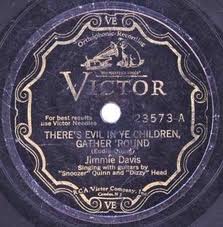
A gem of the Jimmie Davis recording session of 1931 is “There Is Evil in Ye Children” — special because the song was composed by Snoozer Quinn. It’s a real Bible-thumper… the lyrics reveal the concern of a parson who wants to save young people from eternal damnation.
imagesThere is evil in ye children, gather round
Lord there’s evil in ye children, gather round
You go out and drink that gin, you’re so easy to give in,
Lord there’s evil in ye children, gather round

Lord there’s evil in ye children, gather round (gather round)
There is evil in ye children, gather round
I know all of your emotions you must quit those foolish notions
Lord there’s evil in ye children, gather round

Lord there’s evil in ye children, gather round
There is evil in ye children, gather round
You go out with good intentions, what you do won’t do to mention
Lord there’s evil in ye children, gather round

Lord there’s evil in ye children, gather round
There is evil in ye children, gather round
You go out ’bout half past nine, nothing good is on your mind
Lord there’s evil in ye children, gather round (gather round)

There is evil in ye children, gather round
When you want your sins all drowned, come and see old Parson Brown
Lord there’s evil in ye children, gather round (old Parson)

There is evil in ye children, gather round
When you feel love’s temptation come to me and get salvation
Lord there’s evil in ye children, gather round

The form and melody is based on the traditional folk tune “She’ll Be Comin’ Round the Mountain,” which itself is derived from a Negro spiritual called “When the Chariot Comes.” This is a rare example on the Davis recordings where Quinn displays his unusual two-guitar sound. You can hear it in the breaks: Quinn pays a melodic lead enveloped by a driving rhythm part. The sound is comparable to Big Bill Broonzy’s. Quinn exhibits a great country blues sensibility – a relaxed sense of meter, improvisatory melodic style, and bluesy embellishments – as well as fine lyrical abilities and a sense of humor.
Update on the Acetate

Doug Pomeroy, a very kind friend (and a wonderful archivist), digitized the acetate I received a few weeks ago from the Blanchard family. Unfortunately, the record did not contain any music. It was a letter to the folks back home from the man himself, Claude Blanchard, Sr. I believe it was recorded in the late 1910s. It reveals a sparkly personality, a quick manner of speech, love of food (especially cafeteria style chicken — he was a hungry serviceman after all). He also talks about plans to dress up on his return home. He was a dandy!

The first side is scratchy , and the second side is clearer. On the first side, Claude sings a lyric. I am hoping to discern the lyric and try to match it to a popular tune. Was it something he learned? Or was it a composition in the works? He has a wonderful voice, that much is clear.

Even though this acetate didn’t turn out to be a treasure of early jazz music, it’s still very special. The Blanchard family is delighted to have this preserved. Thanks Doug!

Bogalusa, Trains, Songs

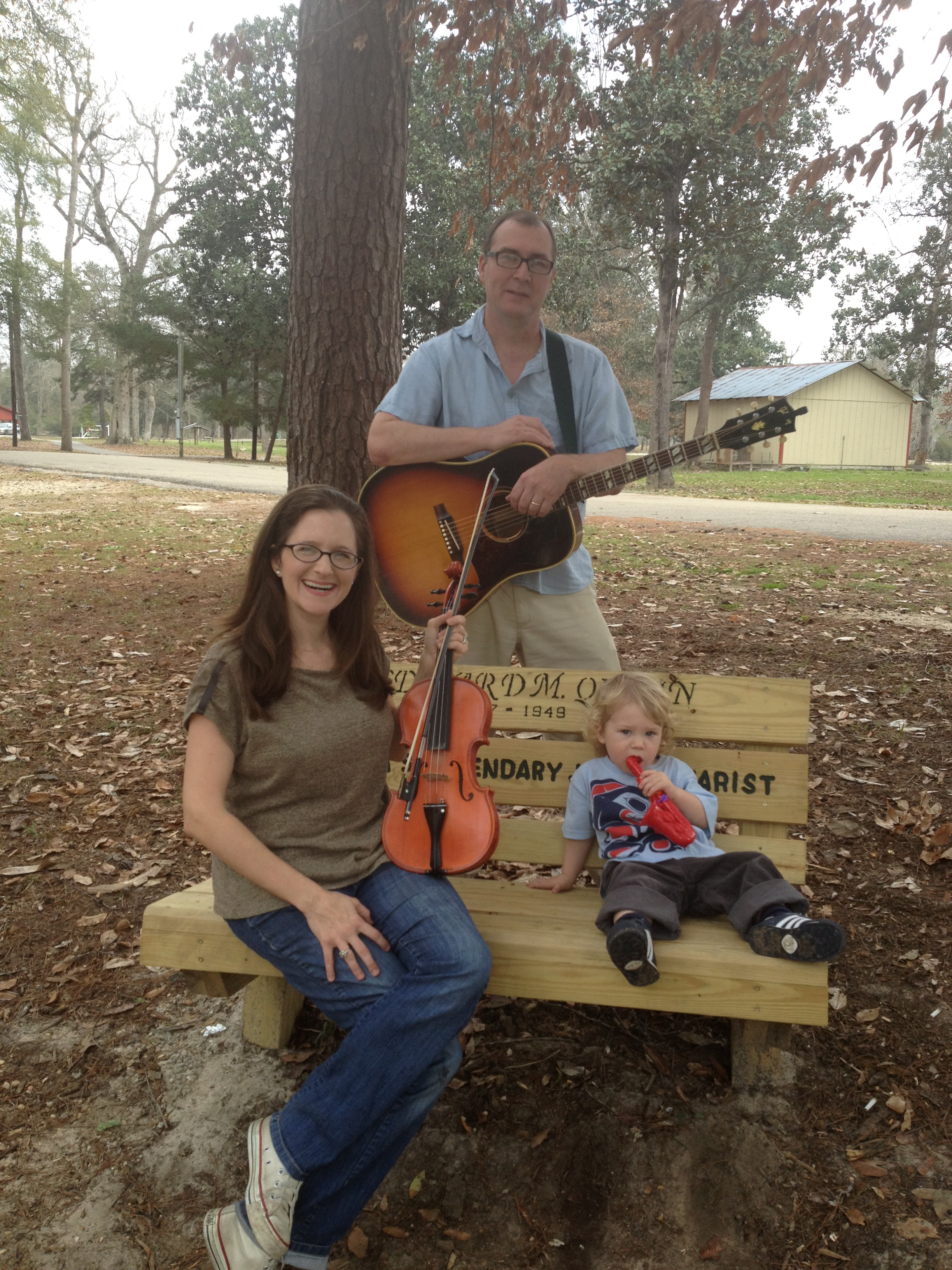
Ray family posing on Snoozer's bench.

Ray family posing on Snoozer’s bench.

My family recently had the opportunity to perform train songs with Foots Quinn, Snoozer’s nephew, at an event in Bogalusa. Foots is a train fanatic! He goes on rides around the country all the time, just for fun, and has recorded a CD of train songs. (I play a little country fiddle on some of the recordings.)

My husband Dave sang “My Baby Think She’s a Train,” “Desperados Waiting for a Train,” and “Texas 1947.” I sang “Hobo’s Lullaby” and “The L&N Don’t Stop Here Anymore.”

Foots recently installed two benches on the edge of the Boque Lusa Creek in Cassidy Park. (Bogue Lusa means “dark waters” in the Choctaw language.) The benches are memorials to Eddie “Snoozer” Quinn and Richard “Dick” Quinn, who passed away two years ago. (Dick was another of Snoozer’s nephews.)

Above is a photo of my family posing on Snoozer’s bench. Little Louis is a budding musician. He can’t decide between red plastic sax, guitar or drums. Below is a photo of Foots.

Foots Quinn playing some train songs.

Foots Quinn playing some train songs.


Charles Eckhart Studiodisc

When I met with Claude Blanchard’s descendants, of course, I asked, “Did your father ever make any recordings?”They shook their heads no… but then, a little light went off.

“Well,” said his daughter Claudia, “We do have this one record that says studio disc… and it’s not in the best shape. But you can take it and see what you can do with it.”

My heart stopped for a second. I don’t have to tell readers of this blog what a rare opportunity this is.

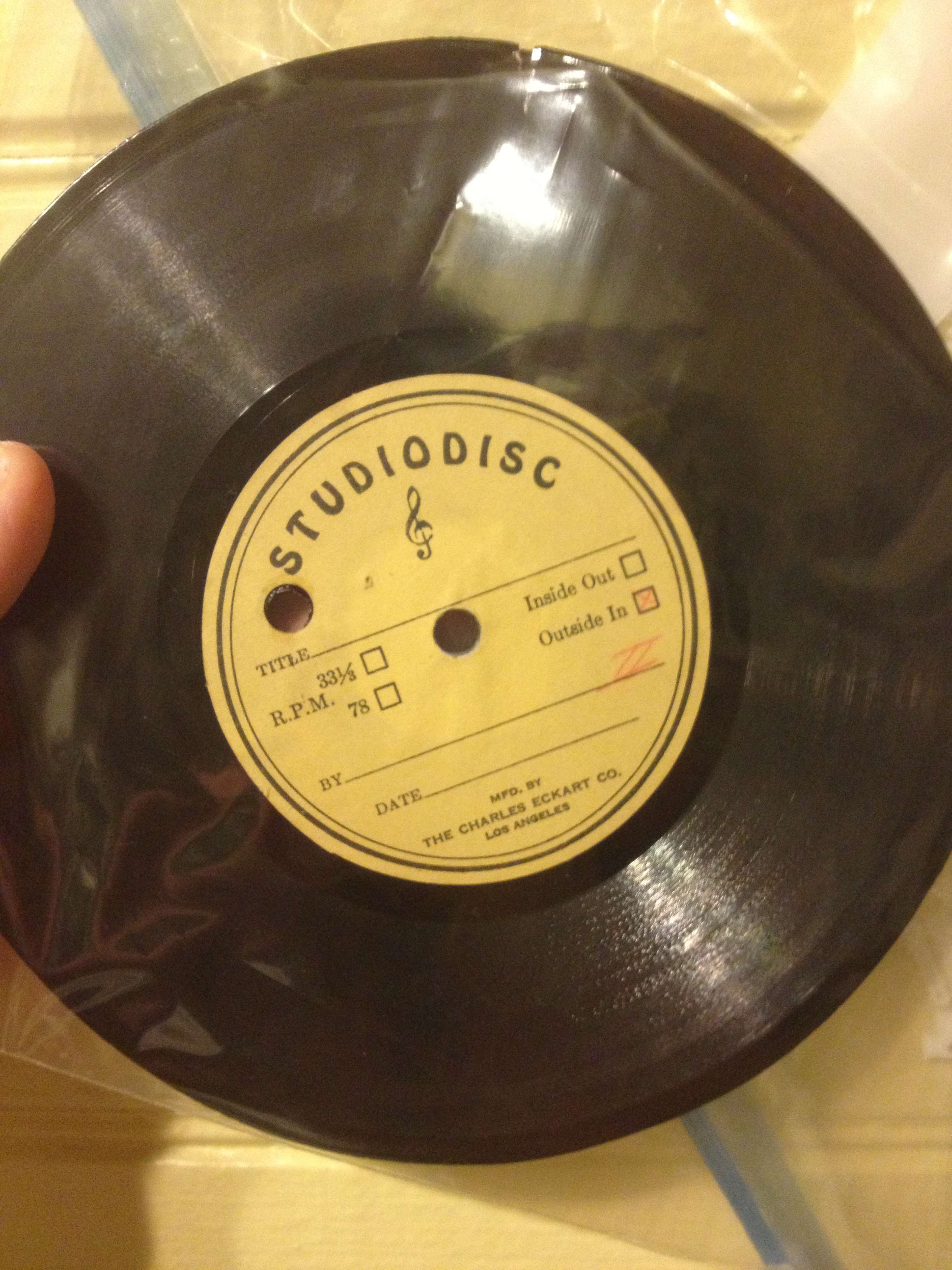
A few days later, I met Claudia at her work to pick up the recording. It wasn’t what I expected… I guess I was expecting a 78, or an acetate disc, or wax, or something big and heavy. But what she gave me (inside a Ziplock bag) was small, like a 45 — only without the big hole — and quite lightweight. It has a serious gouge on the outermost band (like a sawed cutout), and what look like borderline cracks. But moving inward toward the center it’s quite solid, and the grooves look to be in very good condition.

Studiodisc from the Blanchard family collection

Studiodisc from the Blanchard family collection

There is nothing to indicate what band or what songs are on the record, or when it was made. The label is stamped, “Mfd. by the Charles Eckardt Co. Los Angeles.” In red ink, someone has handwritten “I” on one side, and “II” on the other, and checked a little box to indicate the record should be played from the outside in.

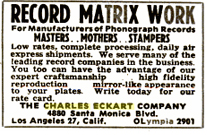
What is this? It measures 6.5 inches in diameter. Some Google Books research into the Charles Eckhart Company uncovered lots of Billboard advertisements. It looks like they provided a reproduction service — maybe musicians could send off their rejected artist pressings to this company to get copies made? (That is my hope.)

Billboard Jan 6, 1951

Billboard Jan 6, 1951

It seems like Eckart was in the business for 15 years — from about 1940-1955. So this disc was made sometime in those years. But the recordings on it could potentially be older.

I’m working on the next step… how to recover the information on this record.

(By the way, doesn’t the last sentence of the article below make you just shudder? “10 cents per pound for acetates, mothers and masters in its custody.”)

Billboard Jun 11, 1955

Billboard Jun 11, 1955


Blanchard Orchestra

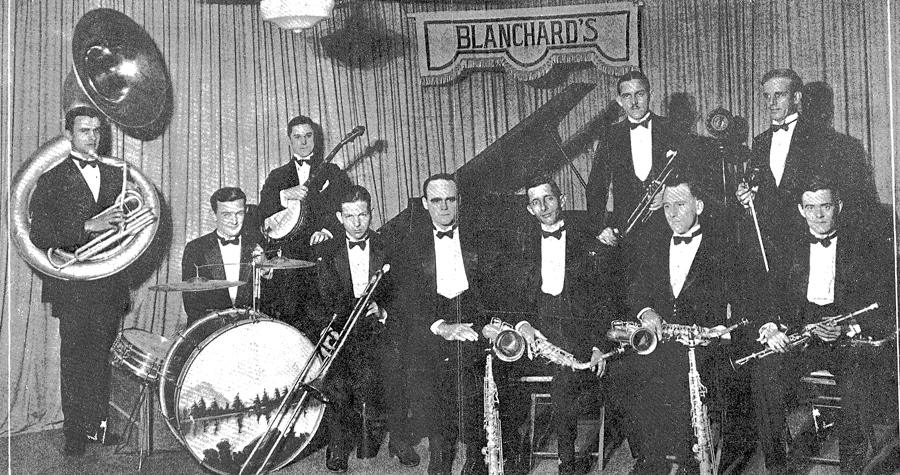
The Blanchard Orchestra

The Blanchard Orchestra in Texas. Claude Blanchard, the leader, is holding a trumpet (fourth from right).

I’ve been researching the Blanchard Orchestra, which Snoozer joined as a kid when he was just 12 or 13 years old! In Bogalusa the band played constantly from January 1920 through fall of 1922, when Claude Blanchard moved to Houston for work with the rail road.

In Houston, Claude built his orchestra back up, and earned a great reputation playing on KPRC and for hotels and clubs. In 1925, Snoozer left Louisiana and headed to Houston to join his old Bogalusa friends — Blanchard and Frank Tilton, a blind, wunderkind piano player — who were earning money and having a ball playing music, to great reception by Texas audiences.

This past weekend I had the absolute pleasure of meeting Claude Blanchard’s descendants. I met Claude’s son, Claude Blanchard Jr., who is 87 years old, and his daughter  Claudia Blanchard and her husband Ingram. (My husband and I drove to Houston to meet them, toddler Louis in tow.)

Not only were they delightful people, but the visit was one of those dreams come true for a researcher. It turns out that Claude Blanchard Sr. documented his career. The family has his scrapbook, which is filled with newspaper clippings of their Texas-era gigs. I gently looked through it, marvelling at the names I recognized. Connections were snapping together in my head, relationships cemented. Mart Britt, Jack Teagarden, Peck Kelley, Jack Willrich, Red Stuart, Johnny James, Roy Riley, Benny Guzzardo…these names, which are important to me, popped out from the text. (Eddie Quinn’s, too!)

The family is scanning the book and sharing images with me… plus, there are boxes of photographs to go through. And letters! Claude Blanchard, Sr. was a letter writer, and his wonderful descendants had the foresight to save many of the letters.

Of course, I am hoping to find some photos and references to Snoozer in the mix.

Claude Jr. also has wonderful memories of the band… He was born in 1925 and remembers singing novelty songs — he and his little brother Don — with his Dad’s orchestra. I’m interviewing him to record some of these delightful memories for posterity.

A second post will follow this, to discuss a recording mystery.